A sofa can point into a room without pointing straight at the other seat. These two original fictional plans keep one chair and one table fixed while the same sofa changes position and orientation. The new dashed lines make a particular consequence visible: an inward arrangement can still have offset facing axes and give the two seats different relationships to the table. Decide which condition matters before treating a wider chair or another table as the missing purchase.
Give the drawn marks a precise meaning
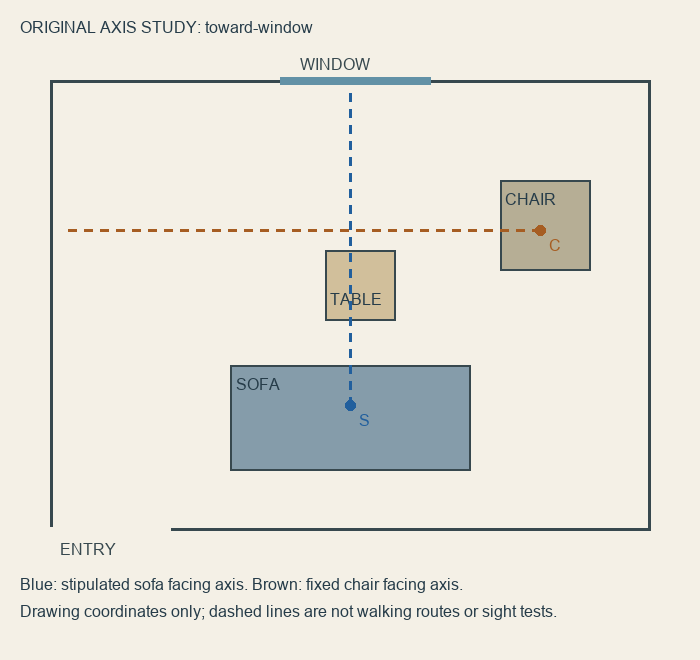
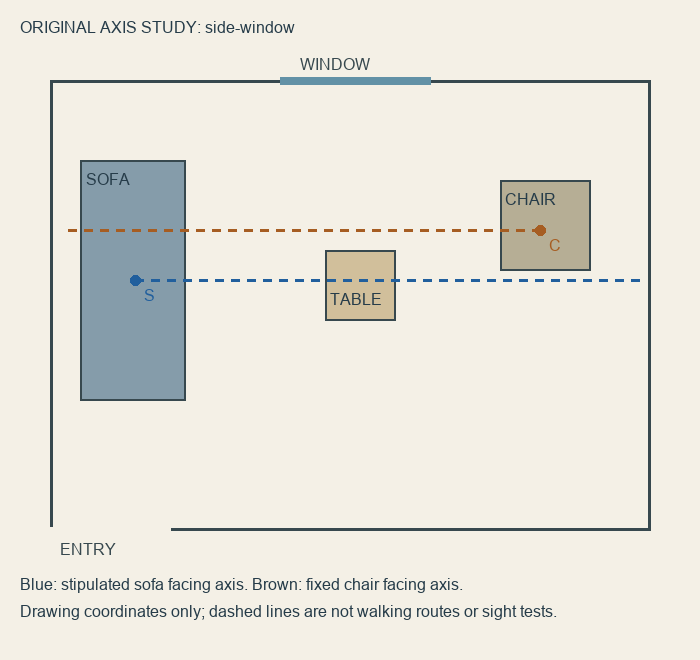
The window occupies the upper wall in both plans. A blue point S stipulates a facing reference on the sofa; a brown point C stipulates one on the chair. Their dashed lines extend the proposed forward axes. These points are not measured heads, eyes or furniture centers. The coordinates below belong to the drawing, with no conversion into real room dimensions.
The chair’s point remains at (540,230), facing left along the horizontal line y=230. The table remains within x=325–395 and y=250–320. IKEA’s planning guidance asks for actual measurements and the locations of openings and other features. Those real details would be needed later; they are not supplied by this deliberately simplified geometry.
Window ahead: crossing axes are not mutual alignment
In the first plan, S is at (350,405) and its blue axis extends upward along x=350. It reaches the drawn window, whose upper-wall span includes that x-position. The axis also crosses the table rectangle before reaching the upper part of the room. Under the declared model, the table and window belong to the sofa’s forward line.
The chair’s brown axis crosses the blue one at (350,230), but that intersection is not either seating point. The chair’s line passes above S, and the sofa’s line passes to the left of C. An intersection between extended axes therefore does not put the two proposed occupants directly opposite each other. Both could look toward another point by turning; the diagram has not tested actual viewing.
Sofa inward: opposite directions can remain offset
In the second plan, the retained sofa is on the left and S is at (135,280), facing right. C still faces left from (540,230). The two axes now run in opposite directions but on different horizontal lines, fifty drawing units apart. Moving the sofa inward has not by itself made a face-to-face pair on one line.
The table gives the offset a second consequence. The sofa’s y=280 axis passes through its rectangle, while the chair’s y=230 axis passes above the table’s top edge at y=250. In this stipulated view, the same table is ahead of one reference point and off the other’s forward axis. Saying that a table is somewhere between two pieces would conceal that asymmetry.
Name the combination that the retained conditions cannot supply
Suppose the household wants the window directly on the sofa’s forward axis, the two seating references on one opposing axis, and the fixed table ahead of both. Neither proposal supplies all three. The second fails mutual alignment and gives the table unequal axis relationships; the first puts the window ahead of the sofa but does not align it with the chair.
Keeping the chair facing left means that an exactly opposing sofa axis would also be horizontal through y=230. That line cannot also reach the upper-wall window in this plan. This is a conflict among declared drawing goals, not a statement that real conversation needs rigid alignment or that either arrangement is unusable.
Keep a piece; reconsider the condition before buying
If the window-axis goal matters most, I would retain the sofa and investigate the first proposal using the real room information. If exact seat-to-seat alignment matters most, I would reconsider the fixed-chair or fixed-table condition before ordering furniture. Merely buying a broader chair does not change the reference line we stipulated for it.
The decision is therefore more specific than choosing outlook or company. It is which alignment to preserve, which fixed condition may change and whether a proposed purchase answers that particular problem. These plans establish no clearance, lighting, glare or comfort result; they keep a geometrical mismatch visible long enough to avoid shopping around an unexplained one.
Sources & further reading
Published sources for the details and examples discussed in this story.