A recycled-content percentage needs an object as well as a number. Sixty percent of an outer fabric is not automatically sixty percent of a complete jacket. The FTC's published Green Guides provide a useful way to read that difference: section 260.13 addresses recycled-content claims, while the general principles ask that the product, package or relevant portion be identifiable. Our two jacket statements are invented examples of claim scope, not labels taken from a real seller or results of a material test.
Read the component in the sentence
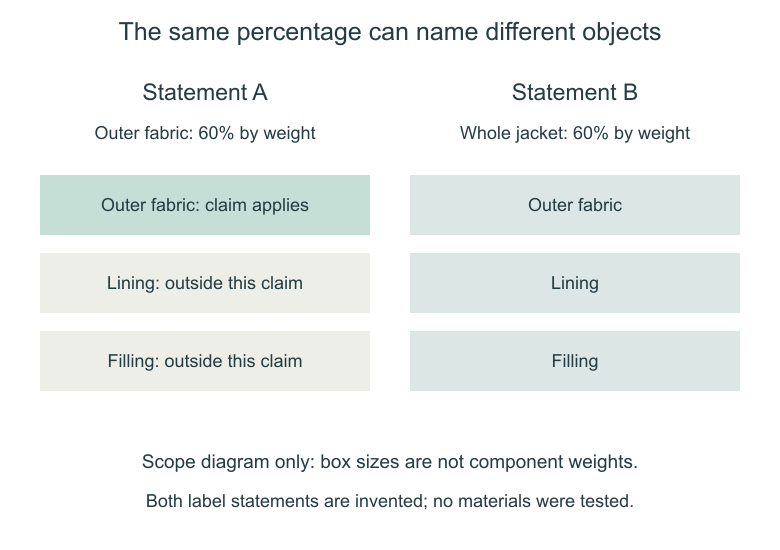
Consider statement A: “The outer fabric contains 60% recycled material by weight. This statement does not cover the lining or filling.” The named subject is the outer fabric. The percentage describes that subject, and the second sentence explicitly leaves two other components outside the claim.
A reader can preserve that scope in an ordinary note: outer fabric, 60%, by weight; lining and filling not covered by this statement. There is no need to convert the note into a conclusion about the whole jacket. Equally, the exclusion does not establish that the lining or filling contains no recycled material. Their content is simply not supplied by the invented statement.
Now read statement B: “This jacket contains 60% recycled material by weight.” Its subject is the jacket. The same printed percentage is attached to a larger object. Statement B therefore asks for support about that object, rather than merely repeating statement A in a shorter form. Removing the component words changes what the claim says.
Keep the quantity and its basis together
Section 260.13 says partially recycled products or packages need a clear qualification about the amount or percentage by weight. The provision also distinguishes material diverted from the waste stream during manufacturing from material recovered after consumer use. A claim that distinguishes those sources needs support for that distinction.
For our reading exercise, the critical information is the boundary of the amount being described. Statement A supplies a percentage for the outer fabric. It gives no component weights and no recycled-content figures for the lining or filling. We therefore cannot derive statement B from it. Knowing the jacket has several named parts is not the missing quantitative evidence.
The accompanying scope diagram deliberately supplies no material weights. It places the outer fabric claim beside a separate whole-jacket claim so the boundary remains visible. It is not a bill of materials, a measured garment or a calculation of an actual recycled share.
A small qualification can carry a large distinction
The Green Guides' general principles say the context should make clear whether an environmental claim concerns a product, its packaging or a portion. The recycled-content section gives a multi-component packaging example in which a claim about the recycled box should not be extended to its unrecycled plastic covering. We use the component distinction, not that example's product or wording, for our original jacket comparison.
This does not let us decide from a label photograph whether a seller has adequate evidence. A clearly bounded sentence and a substantiated sentence are separate questions. Our examples demonstrate what each sentence purports to describe; no supporting supply-chain record has been supplied for either one.
If a real listing leaves the boundary unclear, ask whether the stated percentage applies to a named fabric, a complete component or the finished garment, and what basis the seller uses. Keep the answer with the exact item and claim version. A broad description elsewhere in a collection should not quietly replace the statement attached to the item you are considering.
Compare the claim you actually have
A shopper comparing two jackets might find one component-specific statement and one whole-item statement. The larger-looking percentage does not settle which garment contains more recycled material overall when the claim scopes differ. It also does not settle durability, fit or what will happen to either garment after use.
The useful first result is narrower: describe the claim accurately before comparing it. If only statement A is supported, retain outer fabric in the summary. Do not promote it to a whole-jacket percentage for a tidier product card. Precision about the component can prevent the comparison from claiming more than the supplied information establishes.
Sources & further reading
Published sources for the details and examples discussed in this story.