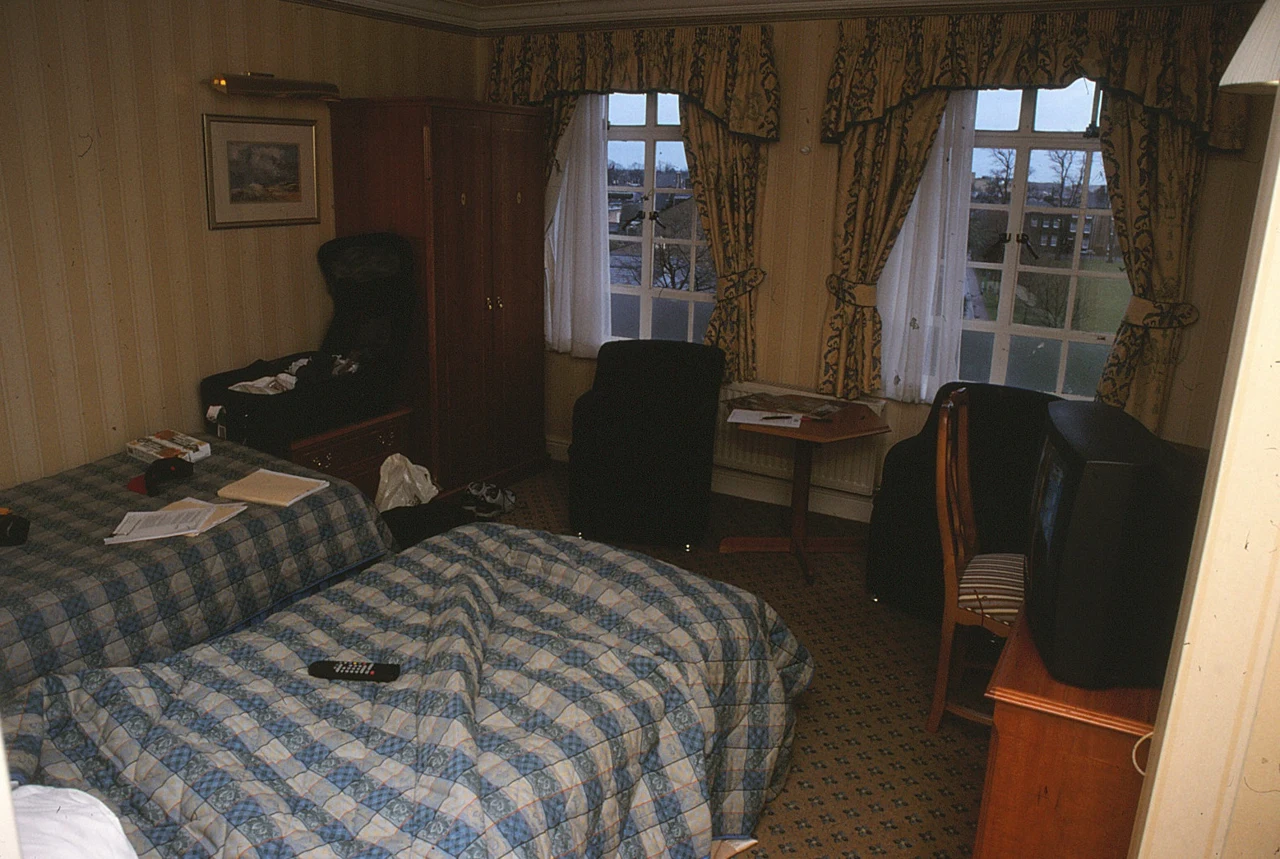
Three adults can agree to share a room and still choose a room that does not permit three occupants. A photograph of two beds cannot settle that problem. Hilton Barcelona's published property policy states a maximum of two people per room and three for suites, says the maximum cannot be exceeded, and says extra beds are unavailable. Here is an original three-adult calculation using those limits, with room capacity kept separate from the sleeping arrangement and the rooms that can actually be booked.
Count people before counting beds
Our fictional party consists of three adults, each staying on the same two nights. Nobody joins for only part of the booking, and no child or infant exception is being assumed. That gives us one clear input: three occupants need an allowed arrangement for both nights.
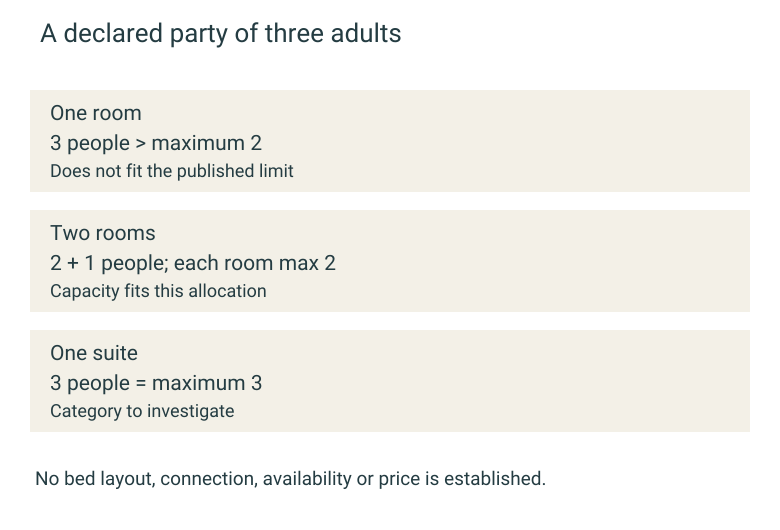
The property policy supplies the second input: a maximum of two for an ordinary room. Three is greater than two. One such room therefore does not accommodate our party within the published limit, even if the adults believe they could share the visible beds comfortably. Their willingness does not change the stated maximum. Neither does choosing a room with a larger-looking floor plan.
This is the step to finish before comparing an attractive nightly figure. If the party cannot use the offered configuration as intended, its apparent price advantage answers the wrong question. The arithmetic should eliminate that configuration before the group starts negotiating who sleeps where.
Two rooms solve a different part of the problem
Two maximum-two rooms have four places of permitted capacity in total. Our three adults can be allocated two in one and one in the other, leaving one place unused. There is no obligation in this arithmetic to fill every permitted place. It simply shows that the party count no longer exceeds either room's stated limit under that allocation.
That does not make the two rooms connecting, adjacent or even on the same floor. Imagine that two friends prefer to share and the third wants a separate room: the two-plus-one allocation may be a useful starting brief. If all three require an internal connection, the calculation has not answered that requirement. Keep the connection question beside the capacity calculation rather than hiding it inside the phrase two rooms.
The group must also compare the full offers for both rooms over both nights. A single displayed nightly price is not the price of the two-room arrangement. We have supplied no live rates, so there is no numerical conclusion about which option costs less.
A maximum-three suite is a candidate, not a bed plan
The published suite maximum is three. Our party of three matches that ceiling, so a suite within that policy is worth investigating. The equality is useful: it identifies a potentially relevant category without pretending that a reservation has been made.
It does not tell us whether the exact suite has the sleeping surfaces the adults want. The same policy says extra beds are unavailable, so the group should not build its plan around adding one. Ask about the actual selected suite's existing sleeping arrangement, with three adults stated explicitly. A generic suite image or a room name is not a substitute for those details.
One fictional group might accept one shared sleeping surface and another existing place; another might require three separate surfaces. Both groups contain three people, yet they have different practical requirements. The capacity calculation stays the same while the acceptable sleeping arrangement changes. That is why a category can survive the first check and still fail the group's real brief.
Keep both nights inside the comparison
An allowed configuration is useful only if it can be reserved for the intended stay. Our example needs the arrangement on both nights. A suitable suite on the first night alone does not complete the proposed booking; two available ordinary rooms on different nights do not create two rooms together.
Before paying, read the selected offer and confirmation for the actual dates, number of adults, room categories and sleeping details that matter. Compare a two-room total with a suite total only after those configurations meet the group's needs. Capacity, privacy, sleeping surfaces, location within the hotel and price are separate entries in that decision, even when one booking screen presents them close together.
Sources & further reading
Published sources for the details and examples discussed in this story.