Two records can share a sculpture title without describing the same physical object or the same moment of manufacture. The National Gallery of Art holds both an original Little Dancer Aged Fourteen and a later plaster cast after it. Reading their dates together creates a small timeline with a crucial division: the period of modeling belongs to the original work, while the later casting date describes another object. This is a comparison of the Gallery records, rather than an account of handling or inspecting the sculptures.
First establish which object each record describes
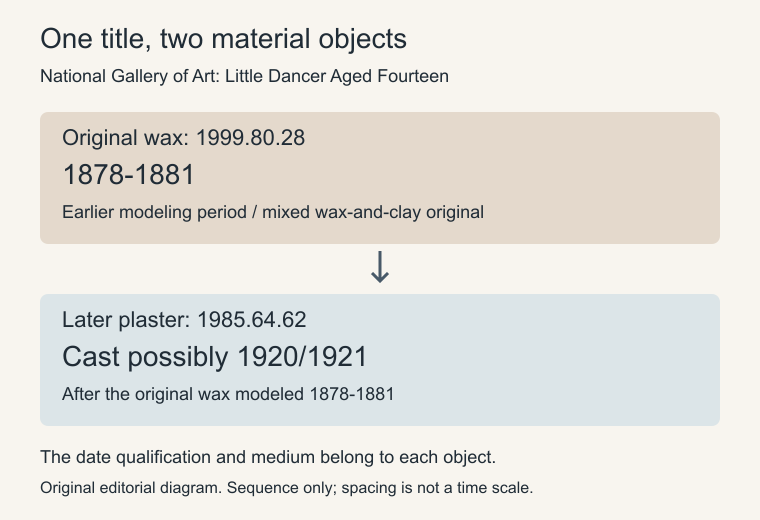
The original has accession number 1999.80.28. The Gallery dates it 1878-1881 and lists a mixed medium beginning with pigmented beeswax and clay, with a metal armature and other materials. Its date range should stay attached to that original object. It is not automatically the manufacture date of every later sculpture bearing the title.
The other record is accession 1985.64.62. Its medium is painted plaster, fabric and a metal armature, on a plaster base. Its dating reads: plaster cast possibly 1920/1921, after original wax modelled 1878-1881. The word possibly qualifies the casting date; removing it would make a stronger claim than the museum makes.
I would place these two accession numbers beside one another before copying any date into a reading note. The shared title establishes a connection, but the identifiers prevent the note from quietly turning two material objects into one. A useful note therefore needs two rows, even when a short image caption could fit on a single line.
Read the two clauses of the later date
The first clause tells us about the later plaster. The second points back to the earlier wax. The relationship is chronological without making the plaster an object physically made in the earlier period. Equally, the later casting date does not replace the earlier modeling period as though the composition began only then.
Imagine a reading-group card whose heading gives only 1878-1881 beneath a photograph labeled plaster. That card leaves the reader unable to tell whether the date describes the represented design or the particular material object. Adding the museum-qualified casting date resolves a different question from correcting a spelling mistake: it identifies which making event the date belongs to.
The resulting timeline has two entries: original wax, modeled 1878-1881; this plaster, cast possibly 1920/1921 after that original. These are the two records compared here. The timeline is not a complete history of every Little Dancer version, and the uncertain later dating should not be converted into a precise day or an invented production sequence.
A later cast is a relationship, not an interchangeable label
The plaster record further identifies it as one of two made at the Hebrard foundry in connection with casting the original wax. The Gallery also explains that bronze versions were commissioned by Degas's heirs after his death in 1917. Neither statement makes the plaster in our second row a bronze, or supplies a date for an unidentified bronze elsewhere.
For a book illustration, lecture note or print description, retain the actual object identifier and medium with the dates. If a different museum holds another version, begin again with its own record. Copying the most familiar date from this comparison would erase the very distinction the pair makes visible.
The value of the comparison is that the same title now carries a more exact question: am I reading about the original modeling, this later cast, or another version whose record I have not checked? That question makes a caption more informative without requiring a verdict about which version a reader should prefer.
Sources & further reading
Published sources for the details and examples discussed in this story.