A room's floor area does not describe the area of its walls. That distinction becomes expensive when a gallon coverage figure is applied to the wrong rectangle. An original 10 by 12 foot room example makes the calculation visible: first find the surfaces to be painted, then account for the number of coats, then compare the result with the particular paint's stated spread rate. The result is a planning estimate with declared exclusions, not an instruction to order a guaranteed quantity for an uninspected room.
Start with a perimeter rather than a floor
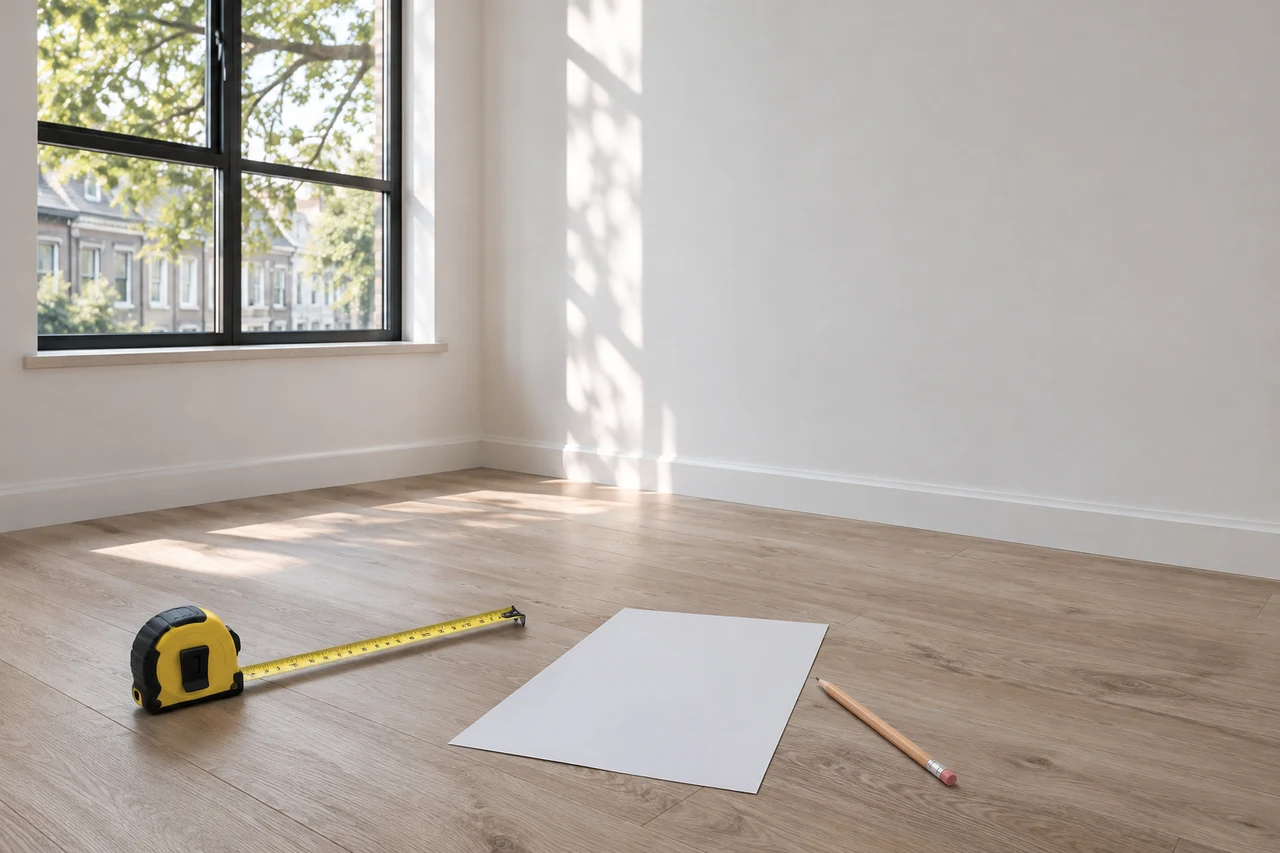
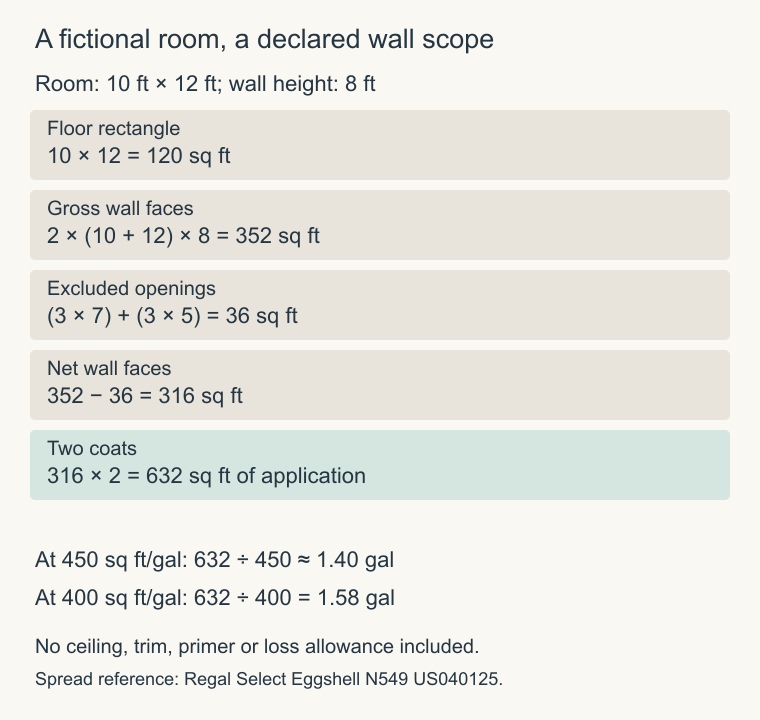
Our fictional room measures 10 feet by 12 feet and has 8 foot-high walls. Assume four rectangular walls with no sloping areas. Its floor is 10 times 12, or 120 square feet. Its wall perimeter is 2 times the sum of 10 and 12:44 feet. Multiplying 44 by the 8 foot wall height gives 352 square feet of wall before any openings are excluded.
The two answers belong to different surfaces.120 square feet describes the floor rectangle;352 describes the four wall rectangles in this invented room. Neither number is automatically wrong. The error would be using the floor result as though it measured the walls, or adding the ceiling without saying it belongs to the painting scope.
Now declare one 3 by 7 foot door opening and one 3 by 5 foot window opening. They contribute 21 and 15 square feet, respectively. Assume only the wall faces are being estimated, excluding these entire openings. Subtracting 36 from 352 leaves 316 square feet. Door and window trim, their reveals and the door itself are outside this calculation, not forgotten surfaces included for free.
Let the coat count change the amount of work
One coat over 316 square feet means 316 square feet of application area. Two coats mean 632 square feet of application area. The physical walls have not doubled in size: the same wall faces are covered twice. Writing both figures prevents the neat room measurement from silently becoming a one-coat assumption.
For a named reference, Benjamin Moore's Regal Select Eggshell N549 US040125 technical sheet lists a spread rate of 400 to 450 square feet per gallon, with recommended wet and dry film thicknesses. It qualifies the result by surface texture and porosity. The sheet recommends two coats for full color development and optimized performance, while explaining that previously painted surfaces can be finished with one or two.
The two-coat choice in our example is explicit. It is not a diagnosis of the actual surface or a claim that the same preparation applies to every room. A quantity calculation cannot establish adhesion, surface suitability or the correct primer. Those questions stay with the exact project and manufacturer's directions before work begins.
Use both ends of the stated spread range
Divide 632 square feet by 450 square feet per gallon: the arithmetic gives about 1.40 gallons. Using 400 instead gives 1.58 gallons. The lower spread rate produces the larger quantity estimate, because each gallon is assumed to cover less area. Keep the units in the division so that an area becomes a volume rather than a new unexplained number.
The difference is useful at the planning stage. It shows that selecting the generous end of the spread range is itself an assumption. It does not supply a universal extra percentage for waste, establish how much paint remains in a roller, or promise that a particular container combination will be sold locally. No such allowance is inserted into these figures.
If the same room were incorrectly reduced to its 120 square-foot floor and a single coat at 450 square feet per gallon, the calculation would give only about 0.27 gallon. That is not a cheaper way of completing our stated work. It is a calculation for a different area and a different number of applications.
Turn the estimate into a clear supplier question
The usable output is therefore a declared scope:316 square feet of net wall face, two coats,632 square feet of application, and an arithmetic range of about 1.40 to 1.58 gallons at the cited spread rates. Bring the exclusions and surface information with that estimate when confirming the actual material quantity.
Ask the supplier or appropriate professional how texture, porosity, preparation and the actual color choice affect the project. Keep ceiling, trim, primer and any other separately coated surfaces on their own lines. A gallon price becomes comparable only after everyone is pricing the same work. The calculation is most useful when another person can see both its assumptions and what it leaves out.
Sources & further reading
Published sources for the details and examples discussed in this story.