The flowers arrive suddenly, but their importance does not arrive all at once. In the Academy of American Poets transcription of Wordsworth’s revised 1815 poem, the encounter and its later return occupy different moments. I read the complete twenty-four lines as a poem about that delay: the speaker sees a great deal before recognizing what the sight can become in solitude.
The solitary opening finds company
At the beginning, the wandering voice compares itself with a cloud moving above a landscape. Then the flowers appear as a crowd. The contrast changes the social language of the scene: the solitary figure encounters a company, even though the company consists of daffodils rather than people.
That language does not require us to identify a real walking route or reconstruct the author’s state of mind. Its work is visible within the poem. A speaker who began apart from things now has something lively to stand before, and the scene can be read as an encounter rather than a list of attractive natural objects.
The scale grows while the movement repeats
The next stanza extends the flowers into a line and compares their continuity with stars. The large number belongs to that expansive presentation; I would not turn it into a measured botanical count. The poem makes the glance feel abundant, while the repeated dancing gives that abundance a shared action.
The nearby waves dance as well, but the flowers are presented as surpassing them in delight. This comparison matters because the landscape is not uniformly decorative. The voice chooses a particular company within it. The flowers become the scene’s strongest claim on attention, rather than interchangeable parts of a pleasant view.
Looking lasts longer than understanding
The repeated verb for gazing slows the third stanza. Yet the speaker says that little thought was given to the wealth the sight had brought. Looking intensely is therefore not identical with understanding the encounter’s later value. I find that admission more interesting than a simple claim that nature made the speaker happy.
The stanza gives the immediate experience its pleasure while keeping something unresolved. If a reading note stops at the dancing flowers, it misses the delay that prepares the final movement. The poem has already seen enough to become memorable, but the account has not yet reached what remembering will do.
The final dance happens elsewhere
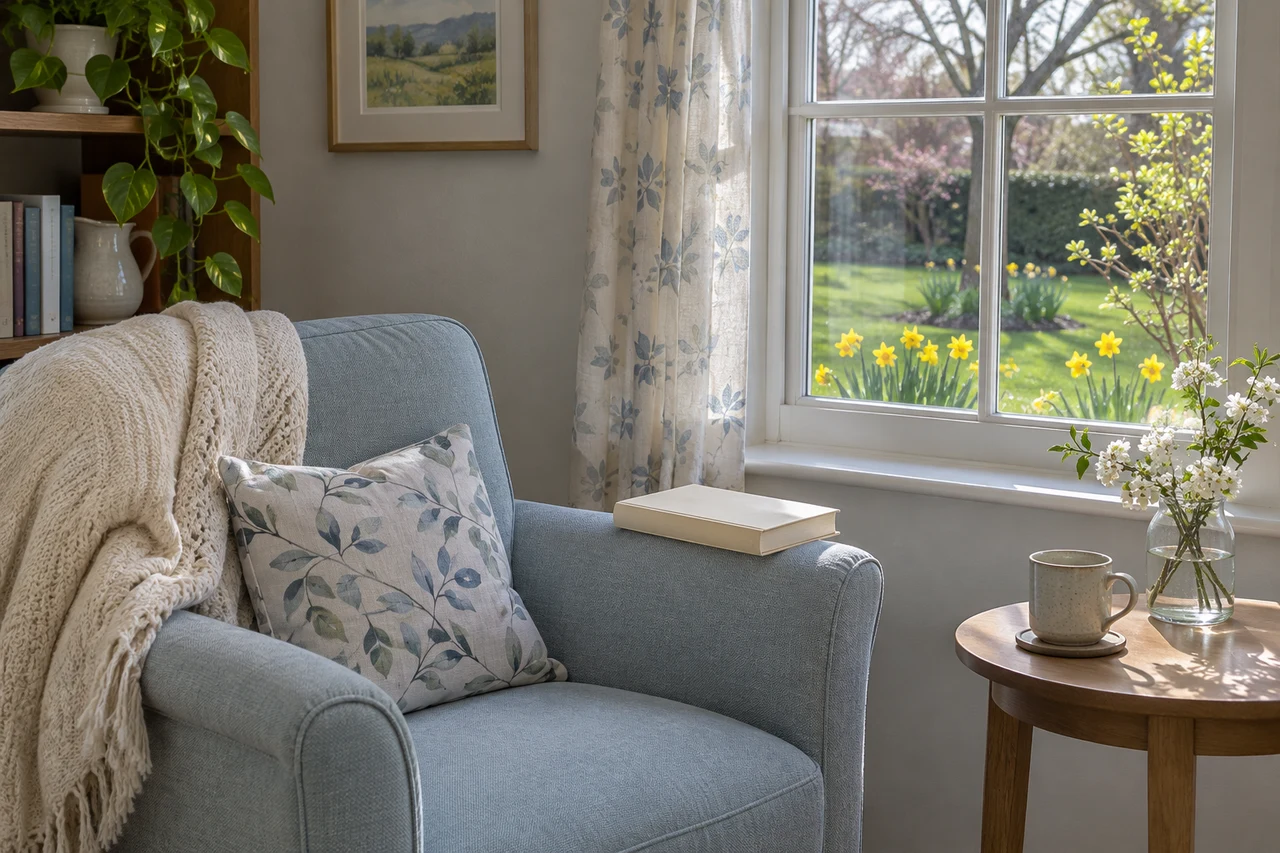
The last stanza moves to a couch and to recurring moments of vacancy or reflection. The flowers return to an inward faculty, and the heart joins their dance. The physical situation has changed: this is no longer another description of the original outdoor scene. Something previously encountered has become available in a different setting.
That is a textual account of remembered pleasure, not evidence for a treatment or a universal response to flowers. When choosing an edition, keep the revised 1815 version identified and retain the final stanza. It lets the earlier unrecognized wealth acquire a form, while preserving the gap between the original gaze and the later return.
Sources & further reading
Published sources for the details and examples discussed in this story.