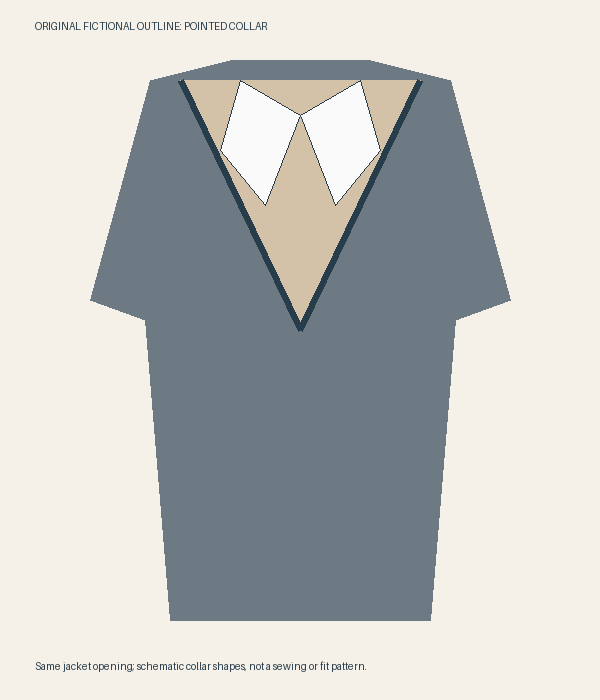
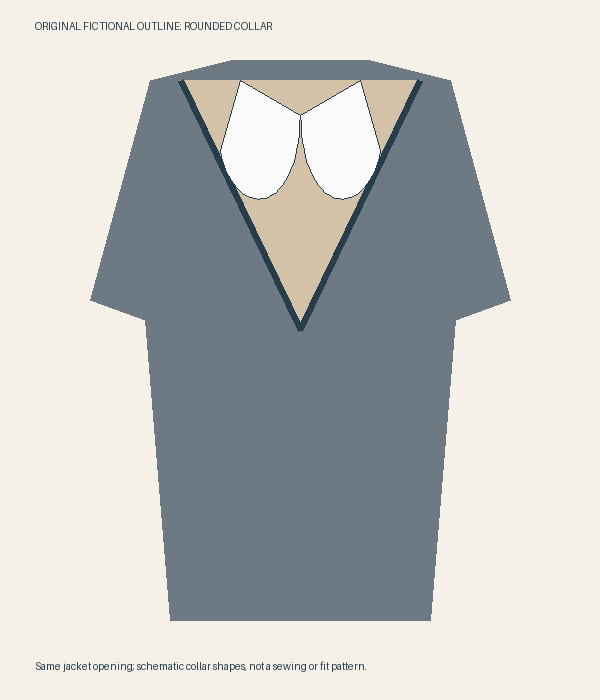
The shirt collar and the opening of a jacket are two lines seen together. They can share an angular vocabulary or let one interrupt the other. Neither choice is inherently more flattering, more formal or better made. Two original schematic drawings keep the jacket opening fixed while changing only a hypothetical collar’s shape. They propose a visual conversation, not a sewing pattern, a garment we handled or a prediction about how fabric will sit on a particular person.
Let the jacket establish the fixed line
In both drawings, a dark V marks the jacket opening. The broad gray body, sleeve outlines and pale inner area remain unchanged. There is no face or measured body underneath the diagram. The first collar has two white pointed lobes; the second has two rounded lobes in the same general part of the opening.
The drawings leave out buttons, seam construction and the actual way the collar would attach or fold. That is a limit rather than an invitation to invent those details. Their job is to make the visible shape relationship inspectable. A real collar with a similar outline might behave differently because of its construction, material or how the two garments are worn.
Pointed: let angles answer angles
The pointed version introduces two lower tips and several straight edges inside the jacket’s larger V. Its edges are not all parallel to the jacket. What they share is an angular way of turning: straight segments meet at distinct corners. I read the shirt and jacket as related shapes, with the smaller points developing the opening rather than making an entirely different kind of mark.
For an imagined outfit intended to keep that direction consistent, this would be my first version to investigate. I would keep the rest of the proposed upper-body composition comparatively quiet while deciding whether the extra points are welcome. Adding a tie, patterned scarf or large necklace would create another relationship, rather than prove that the collar needs more decoration.
Rounded: give the V a curved neighbor
The rounded version keeps the jacket’s corners but puts curved lower edges beside them. The white lobes still meet near the upper center, while their bottoms turn without the sharp tips seen in the first study. The contrast is therefore inside the same opening. It does not depend on changing the jacket to a different color or moving the whole garment.
I find this version more interesting when the proposed outfit needs an interruption rather than another echo. That is a preference about this drawing, not a rule that rounded collars make a person appear younger, friendlier or less authoritative. The curves offer a different line. They do not tell us the wearer’s personality or establish a dress code.
Carry a visual preference into an actual choice
Getty’s formal-analysis guide describes lines through properties including direction and curvature, and notes how lines define form edges. That vocabulary helps explain the comparison without turning it into a claim about garment engineering. The actual source does not assess either of our imaginary collars or provide a fit recommendation.
Before buying a shirt specifically for an existing jacket, inspect the actual combination where possible. Check the exact garments, care requirements and relevant return conditions rather than assuming a diagram proves compatibility. Look at what remains visible when worn as intended. A collar that disappears inside the jacket, catches awkwardly or cannot be worn comfortably is a different practical issue from whether its outline looks related in a flat drawing.
If both real options work appropriately, choose the visual job deliberately: repeat the angular opening or introduce a curved neighbor. There is no requirement to own both. The comparison earns its place when it makes one choice easier to describe, rather than supplying a universal list of correct collars for different bodies.
Sources & further reading
Published sources for the details and examples discussed in this story.