A short plaque can connect a name to a building without supplying the whole history between them. George Orwell’s blue plaque at 50 Lawford Road offers a precise example. We read English Heritage’s documented inscription and account online, not the plaque during a visit. Three questions keep the small text useful: what does it name, whose act of commemoration is it and what should we ask the institutional account next?
| Reading layer | Actualbasis | Limit |
|---|---|---|
| Whatitnames | Orwell;1903–1950;professionalroles;placeconnection | Inscriptiondoesnotdate residence/namebook |
| Whocommemorated | Record:GLC erected1980 | Latercommemorativevoice, not Orwell’sownstatement |
| Questionforinstitution | Whichworkbelongswiththisresidence? | EHstatesbulkofKeep theAspidistraFlying;notdailywritingroutine |
First reading: copy only what the short text establishes
English Heritage transcribes the inscription as: “GEORGE ORWELL 1903-1950 Novelist and Political Essayist lived here”. The text identifies a person, his dates, two kinds of writing and a connection with the place. It does not give the months of residence or name a book written at the address.
That small distinction can prevent an invented story. Seeing the title of a famous novel elsewhere on a tour map would not establish that it was written inside this building. A marker’s brevity is not permission to fill the missing details from a loose association.
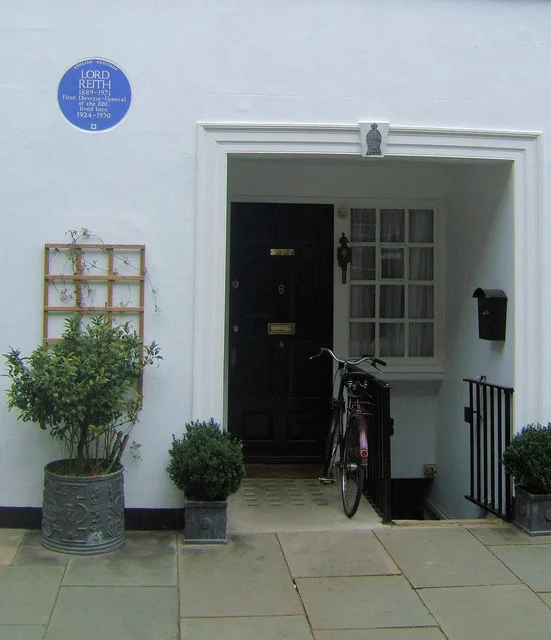
For a personal note, I would preserve the actual address and the institutional source alongside the inscription. That keeps the place connection distinguishable from other residences, other memorials or a photograph whose location has been guessed. The contextual photograph reproduced with this article shows the entrance and Lord Reith plaque at 6 Cowley Street, not Orwell's plaque or 50 Lawford Road. It illustrates a different blue-plaque setting; it is not visual evidence for the Orwell inscription or address discussed here.
Second reading: notice the later commemorative voice
The English Heritage record identifies this as a plaque erected by the Greater London Council in 1980. The short text is therefore a later act of commemoration, not a statement Orwell wrote about his own room. Its professional labels offer a compact way of presenting why the person is being remembered.
I read that framing as an invitation to follow the writer’s work, rather than a complete account of everybody who used the building. This is a limited interpretation of the named plaque and its record. It does not prove a hidden intention, establish what every passerby thinks or authorize a general claim about all blue plaques.
Asking whose account is speaking also leaves space for the other people a longer history might discuss. The absence of their names from a small marker does not establish that they were absent from the place. It tells us that the inscription has a particular scope.
Third reading: let one question lead to the cited account
The next useful question is: which work does the institution connect to this residence? English Heritage dates Orwell’s stay from August 1935 to January 1936 and states that he wrote the bulk of Keep the Aspidistra Flying there. That is more specific than assigning his best-known book to every address associated with him.
The answer still has a boundary. It does not provide a daily writing schedule or demonstrate that a feature of the room caused a passage in the novel. Those would need further evidence. A good follow-up can stop at what the source actually supplies instead of stretching a useful connection into a complete creative biography.
My resulting note would distinguish three layers: inscription, later commemoration record and the institution’s account of the short residence. Keeping those layers separate makes the plaque a beginning rather than a summary I pretend to have verified in full.
Choose a deeper reading before buying another itinerary
If this connection interests you, compare an actual edition or legitimate sample of the identified novel, or look for a clearly described institutional history resource. Check what a book or paid tour actually covers rather than assuming the presence of Orwell’s name means it explains this period.
The marker’s location does not establish public access to the building, current visiting arrangements or permission to enter. This article has checked an online record, not a route or an admission offer. A useful next step can be reading from where you are, without turning a private-address connection into an invitation.
The exercise also works when the source leaves the follow-up unresolved. Record the question honestly, with the source consulted. A short text has already done something worthwhile if it helps you ask a better, answerable question about the city.
Sources & further reading
Published sources for the details and examples discussed in this story.