Two small brooches can become a pair, two separate accents or a response to the line already drawn by a lapel. The difference is not simply whether the wearer has added enough jewelry. We made three original paper-shape studies with one circle and one triangle on the same schematic lapel. The shapes stand for possible accents, not actual brooches, and no fabric was pinned. Their position lets us discuss a relationship before treating another purchase as the answer.
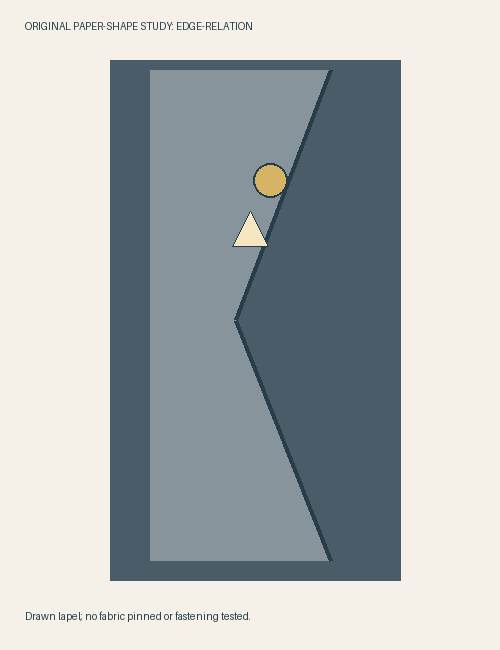
Keep the two shapes and the lapel fixed
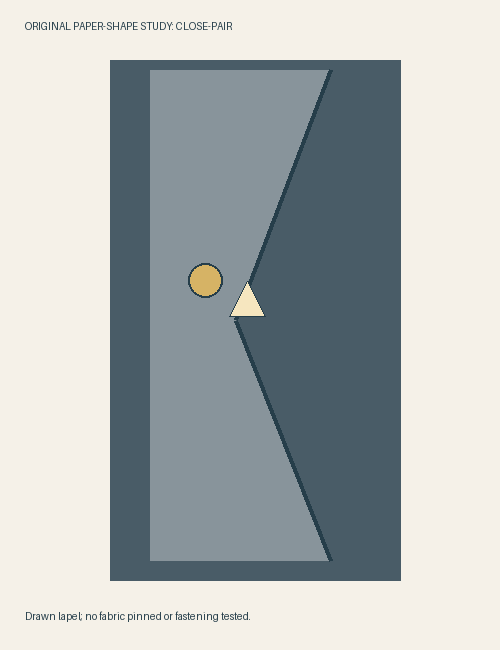
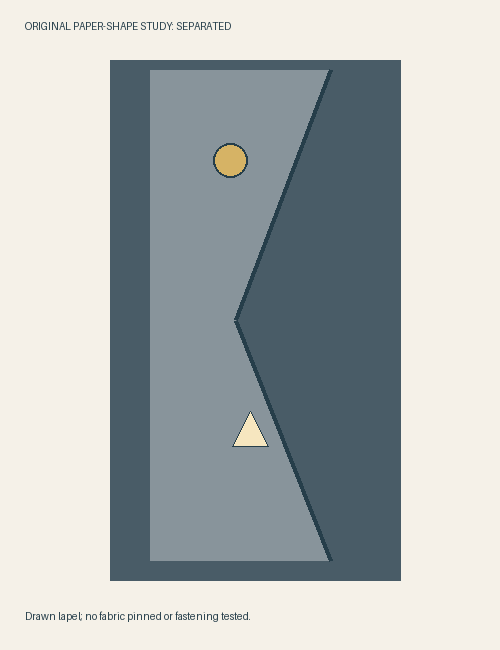
All three drawings use the same pale circular mark and triangular mark, with the same sizes and colors. The lapel’s inner edge descends toward a notch and then moves outward again. That existing change of direction is part of the composition; it does not disappear when an accessory is added.
These are flat drawn arrangements rather than fastening proposals. In two studies, part of the triangular mark reaches across the inner edge. That crossing is available as a visual idea on paper, not evidence that a real brooch could be attached there without obstructing the garment or damaging it. The drawings establish no weight, pin length, fabric strength or practical clearance.
Close pair: make the gap belong to both
In the first study, the circle sits near the lapel’s central area and the triangle appears a short distance to its lower right, near the notch. Their small gap is easier for me to read as an interval within one group than as a division between unrelated decorations. The circle’s curve and triangle’s corners remain different, but they have become immediate neighbors.
This is the version I would develop if I wanted two modest pieces to make one combined accent. It would not need a third small object simply to fill the gap. A different pair of real pieces could have strongly unequal visual weight, so the drawing does not supply a universal spacing rule. It supplies a question about whether the interval feels shared.
Separated: allow two different stops
In the second study, the circle is higher on the lapel and the triangle sits much lower. There is a long stretch of unmarked surface between them. I find myself noticing two stops rather than one small group. The shape difference no longer has a nearby partner; the lapel’s own line becomes a more prominent link between the marks.
That separation could be exactly what a proposed outfit wants. It might also make the second piece feel unnecessary if the upper accent already does the intended job. Removing the lower mark would be a legitimate fourth possibility, not an admission that the owner failed to assemble a matching pair. The useful comparison is between one accent and two distinct stops, not between a sufficient and insufficient number of possessions.
Near the edge: give the pair a third participant
In the final drawing, both marks move toward the descending inner edge, with the triangle again crossing it slightly. The pair’s direction now follows a portion of the lapel instead of sitting independently in its middle. The line becomes a third participant: circle, triangle and edge describe the same small area together.
For this particular paper study, I still prefer the first close pair. It gives the different shapes a relationship without making the garment boundary the main subject. The edge version would be interesting for a proposed look that wanted to emphasize that diagonal. Neither interpretation tells us what another viewer will notice first or how the actual pieces will behave when worn.
Buy a relationship, not an obligation to match
The V&A’s jewellery collection includes historical and contemporary pieces, offering a useful place to explore different forms. It does not prescribe our arrangements, clear a commercial design for copying or establish the fastening suitability of a brooch shown online. Our two simple marks are original rather than tracings of collection objects.
Before buying a second piece, compare its actual scale and intended attachment with the garment and piece already owned. Consult the maker’s relevant information and use appropriate help if suitability is unclear. An appealing paper composition is a reason to investigate, not to push a pin through valuable fabric. Keeping one suitable piece can be a more deliberate decision than buying a nominal pair whose members never form the relationship you wanted.
Sources & further reading
Published sources for the details and examples discussed in this story.