
A semi-flex room rate can stop being cancellable without charge well before the day you travel. The useful number is not simply seven days: it is a particular local-time boundary attached to a particular booking. The Social Hub Glasgow's March 2026 general terms give us one concrete case. The calendar below is an original worked example applying that document, not a reservation we made or a prediction about another hotel's refund decision.
Start with the booking category
The document's ordinary Hotel Stay category covers one to thirteen nights. Its specific clauses apply unless the hotel agreement provides otherwise. A semi-flex label therefore needs to remain attached to the actual offer and confirmation; the label alone does not select the terms for every kind of stay.
For this comparison, assume a hypothetical two-night ordinary Hotel Stay at TSH Glasgow, booked on the semi-flex terms described in A.3. Assume no separately agreed variation. Those assumptions are part of the example. If an actual confirmation names a different cancellation arrangement, return to that arrangement instead of forcing the reservation into our calendar.
Put the boundary on the calendar
The semi-flex clause allows no-charge cancellation with refund until 3 p.m. local time seven days before check-in. After that boundary, cancellation produces no refund and unpaid hotel fees remain payable. We are reading this clause's stated financial consequences, not supplying a general rule for Glasgow accommodation.
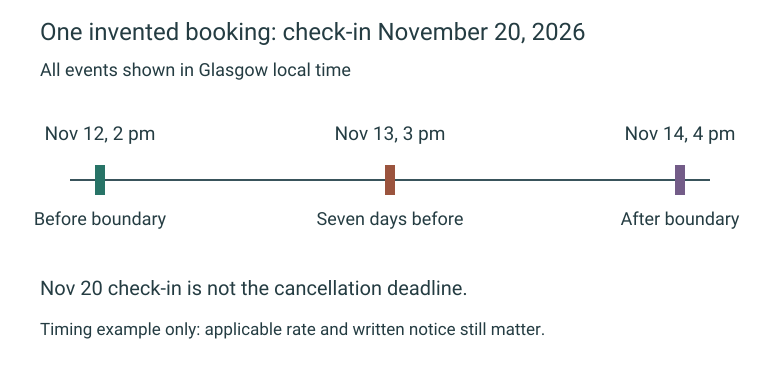
Give our invented booking a check-in date of Friday, November 20, 2026. Seven calendar days earlier is Friday, November 13. The boundary to mark is therefore November 13 at 3 p.m. Glasgow local time. It is not midnight on November 13, and it is not a time chosen from the traveler's home clock. The diagram deliberately keeps every event in the property's local time so the comparison does not depend on an unverified time-zone conversion.
Now compare two fictional decisions. At 2 p.m. on November 12, the traveler decides not to go. That is comfortably before the stated boundary. At 4 p.m. on November 14, the same decision falls after it. The reason for cancelling could be identical in both stories; the difference we can establish here is where the decision sits relative to the contractual cut-off. Avoid designing a plan around the exact second at 3 p.m., where practical questions about communication and recording would still need attention.
Cancellation requires a communicated action
The clause requires written cancellation or modification to TSH Glasgow or the relevant agency; email is sufficient. Our calendar identifies when; it does not demonstrate that a fictional email was sent, received or applied to a real booking. An unsent draft and a completed cancellation are different things.
For an actual reservation, keep the booking identity with the notice and retain the provider's response. If the booking was made through an agency, establish the applicable route rather than assuming that a message to any hotel address changes the agency's record. There is no need to reproduce a payment-card number or a whole private itinerary in a shared planning note merely to make the deadline legible.
A shorter stay is another request
A traveler who still intends to arrive but wants to remove the second night is asking for a modification. For modifications, the section describes possible refunds or surcharges before the boundary. After it, shortening or downgrading gives no refund; lengthening or upgrading depends on availability and may cost more.
Do not treat that as a promise that every requested replacement room or date exists. In our two-night example, changing the trip and abandoning it are two different actions even when the initial reason is the same. Likewise, simply failing to arrive is not the written cancellation described above. This article does not establish a separate no-show charge from the cancellation paragraph; that question belongs with the actual booking's applicable terms.
Compare the flexibility you will use
Before choosing between offers, write one sentence describing the decision you may need to make: cancel the trip, change its dates or shorten it. Then locate that action in the exact rate terms and put its deadline beside the total price. A cheaper offer can be suitable when its limits fit the plan. Paying more for a reassuring label is less useful if nobody has checked when that reassurance ends.
Sources & further reading
Published sources for the details and examples discussed in this story.