
A city budget can authorize an activity without proving that the money has reached a supplier. The distinction matters when a neighborhood conversation jumps from the council approved it to the city already spent it. New York City's fiscal 2024 Annual Comprehensive Financial Report provides a concrete vocabulary for separating the records. The small equipment example below is invented; it illustrates the questions to ask, rather than reporting a purchase by an actual agency.
Begin with the authorization
The report describes budgetary control at the unit-of-appropriation level and identifies that unit with a program, purpose, activity or institution within an agency budget. Its budget notes distinguish annual General Fund expense appropriations from capital appropriations that can remain in effect through project completion unless changed or rescinded.
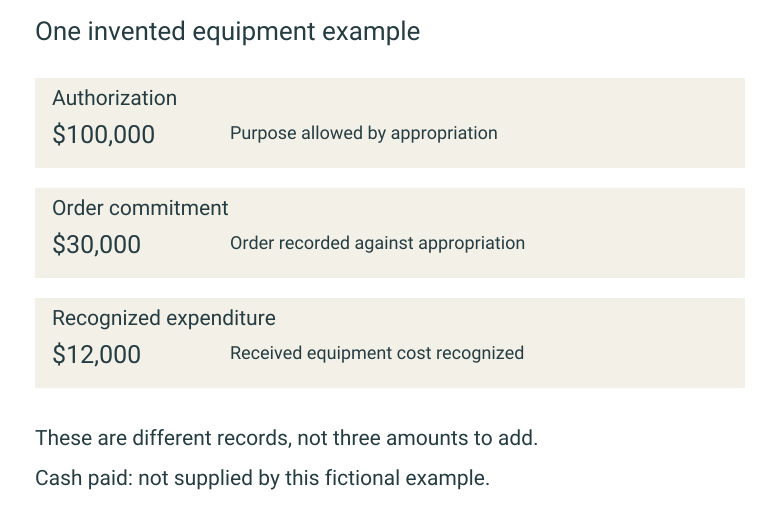
Imagine a fictional note that says an agency has an adopted appropriation of $100,000 for a named purpose. That is an authorization input in our example. It does not name a seller, give a delivery date or show that $100,000 has left a bank account. A headline saying the agency paid $100,000 would add an event that the invented authorization record does not supply.
The helpful next question is narrower than was the budget approved: what record shows the particular transaction we are trying to describe? Keep the fiscal year, fund, agency and appropriation identity together before comparing another number with the authorized amount.
A commitment is not the same record
In its encumbrance note, the report explains that the General Fund records purchase orders, contracts and other expenditure commitments against spending appropriations. It separately describes recognizing the cost of goods received and services rendered by June 30 as expenditures; encumbrances that have not become expenditures lapse at year-end.
Add an invented $30,000 equipment order to our fictional $100,000 authorization. That second number is not a second appropriation. In the story it represents a commitment recorded for the order. It still does not tell us that every item was delivered or that the whole order was paid. A screenshot containing the number 30,000 without its column heading would make those different meanings dangerously easy to merge.
Follow delivery and accounting before claiming payment
Now suppose our invented record says $12,000 of the ordered equipment was received and its cost recognized as an expenditure. We can describe the stated accounting event in the example. We cannot silently rewrite it as a bank transfer on the same day: no payment record has been supplied.
Three original notes now describe three things: $100,000 authorized for the purpose, a $30,000 order commitment, and $12,000 of received equipment recognized as expenditure. They are not three amounts to add together. Nor is $100,000 minus $30,000 minus $12,000 a defensible remaining-budget calculation, because that treatment would assume the commitment and expenditure are independent deductions. Our story has not provided the accounting reconciliation needed for that calculation.
If the question is what a supplier actually received, look for the applicable payment record and its date rather than asking the budget document to answer it. If the question is what was delivered, a payment total alone would still leave the delivery question open. Choose the record for the event the sentence is meant to describe.
Write the modest sentence the evidence supports
For our invented records, a careful summary is: the agency was authorized $100,000 for the stated purpose; a $30,000 order was recorded, and $12,000 of received equipment was recognized as expenditure. Payment timing is not established by the supplied example. That preserves the stages instead of compressing them into the city spent its budget.
A real inquiry would need the corresponding records and definitions for the actual fund and period. This reading is an explanation of the cited New York City report's distinctions, not a finding that an agency underspent, overspent or failed to deliver a service. The useful result is a better question: which part is authorized, which is committed, which is recognized as expenditure, and which is documented as paid?
Sources & further reading
Published sources for the details and examples discussed in this story.